
Scroll down to view research projects
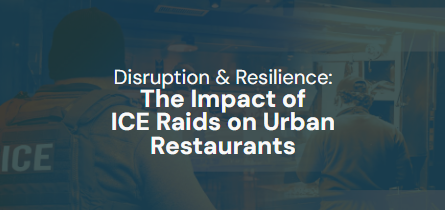
Disruption and Resilience: The Impact of ICE Raids on Urban Restaurants
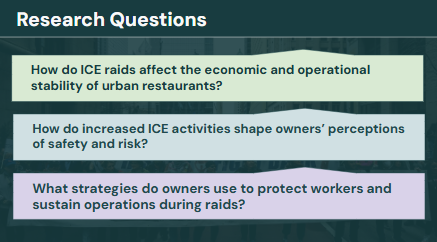
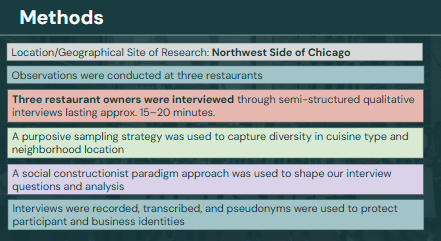
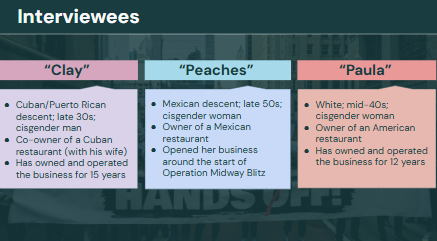
This research highlights how immigration enforcement policies shape the daily realities, economic stability, and sense of safety within Chicago’s restaurant communities. Conducted and analyzed qualitative interviews with Chicagoland restaurant owners on the economic, operational, and social impacts of ICE enforcement, while transcribing, coding, and identifying recurring themes in qualitative research data.
Award
Awarded “Best Podium Presentation” in the Government Themes Session at NEIU’s Annual Symposium for delivering a clear, well-researched presentation of original research findings and analysis.
Abstract
Recent increases in United States Immigration and Customs Enforcement (ICE) activity have significantly impacted urban communities, particularly in the Chicagoland area during Operation Midway Blitz in September 2025 (Hawley 2026). Many communities, especially small, immigrant-owned businesses, have experienced economic and social disruptions, including declining customer activity, business closures, staff reductions, and ongoing fear that keeps residents at home (Savchenko 2025). Jane Jacobs’ (1961) “Eyes on the Street” concept suggests that neighborhoods remain safer when public spaces are active and regularly observed by residents, workers, and business owners. When restaurants and other small businesses close or reduce activity during periods of enforcement, informal social monitoring decreases, weakening community cohesion and perceived safety.
Guided by a social constructionist approach, this study uses semi-structured interviews to examine how increased Immigration Enforcement activities have affected restaurants and will explore the strategies restaurant owners employ to maintain their businesses and support employees. Interviews will take place in the Lawrence Avenue Corridor, a pseudonym used to protect the neighborhood’s identity. Using purposive and snowball sampling, restaurant owners are engaged to assess the impacts of workforce disruptions, reduced customer traffic, and heightened fear. Cultural information, such as food served and community practices, will be retained to highlight community vibrancy and explore patterns of racialized targeting. Any person names and any identifying information will not be included in the research, as pseudonyms will be used as a marker for such information. Recordings and notes will be securely stored and will only be accessed by the researcher. All data will be permanently deleted after the project is completed. The information collected will be used for class purposes, and research findings and general themes may be shared at the Northeastern Illinois University’s undergraduate symposium after receiving Institutional Review Board (IRB) approval in accordance with ethical guidelines; however, no identifying information will be included or disclosed.
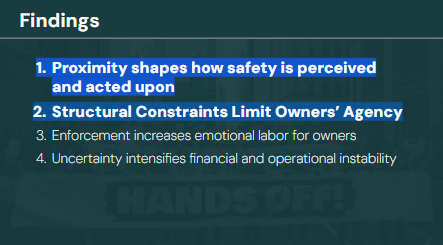
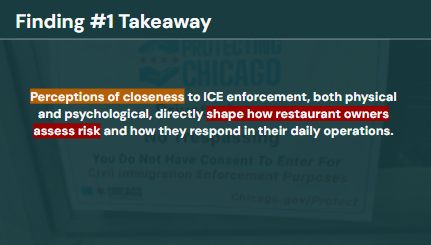
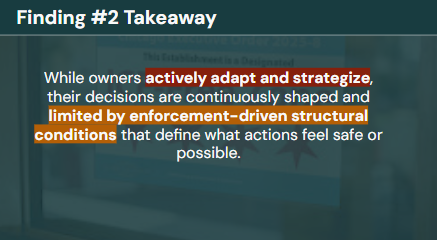
Featured Slides from Research Presentation
Displaced by Development: The Pilsen Food Pantry
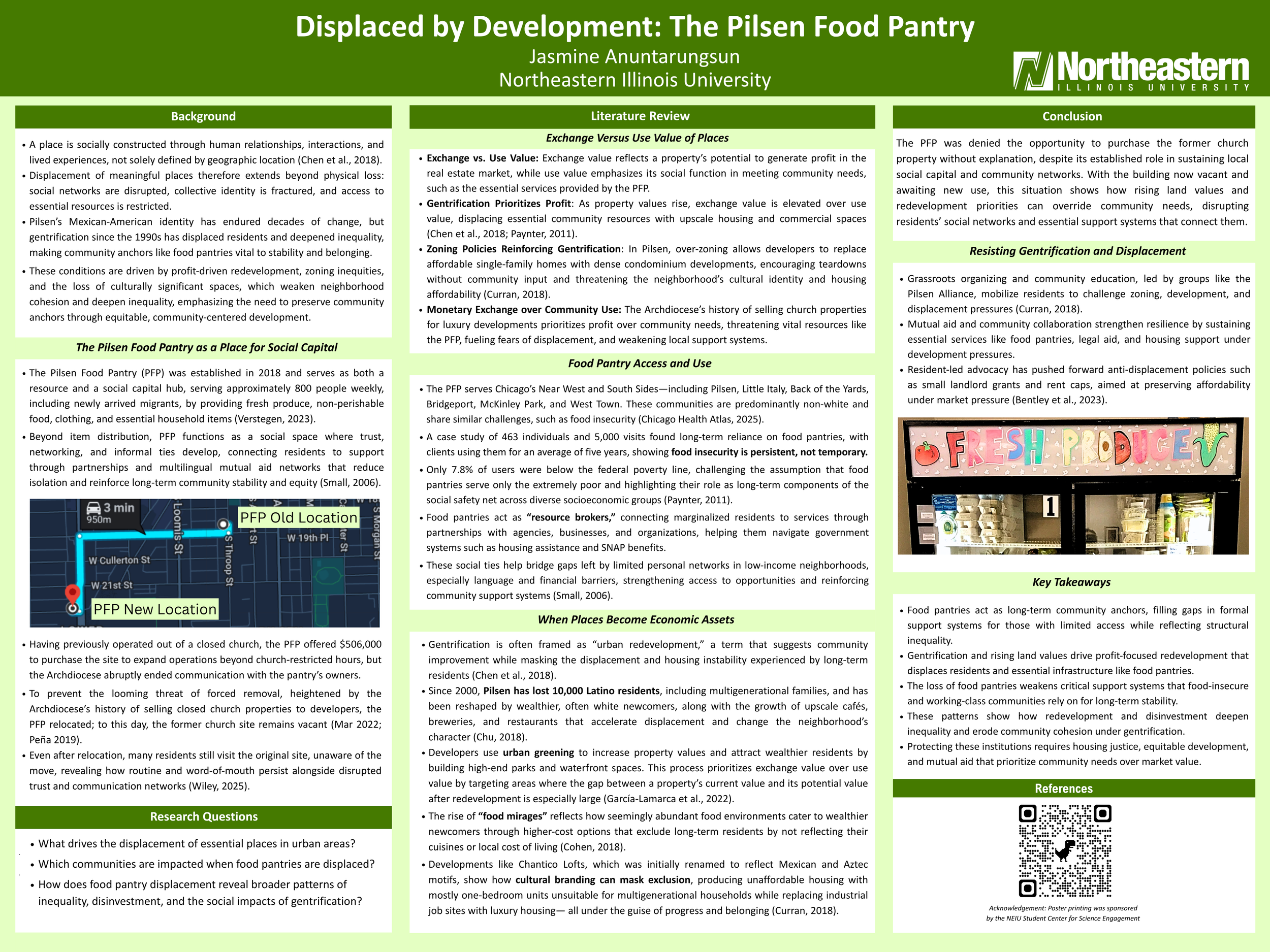
This research examines how gentrification contributes to the displacement of essential community resources and reshapes access to support within historically underserved neighborhoods. Conducted a literature review of 20 empirical studies and a qualitative interview with a local food pantry manager to analyze how policy, economic development, and neighborhood change impact equitable access to community resources.
Award
Awarded “Best Poster Presentation” in the Social Sciences and Humanities Poster Session at NEIU’s Annual Symposium for delivering a compelling presentation on how gentrification drives the displacement of essential community resources.
Abstract
When a community loses a meaningful place, the damage goes far beyond the physical. Displacement fractures social networks, erodes shared identity, and cuts off access to vital resources. When a neighborhood park disappears, where do children play; and where do neighbors gather? A place is not just location; it is created through the people, relationships, and everyday experiences that give it meaning (Chen et al. 2018). The story of the Pilsen Food Pantry (PFP) in Chicago illustrates this clearly. Founded in 2018 in a vacant church, PFP was more than a food distribution site; it was a hub of social connection for longtime residents and newly arrived migrants. As gentrification intensified, the pantry was forced to relocate after its founders’ bid to purchase the building was rejected, prioritizing market value over community need (Chen et al., 2018; Paynter, 2011; Small, 2006). PFP’s displacement reveals how profit-driven redevelopment restricts access to essential services and weakens neighborhood cohesion. Zoning disparities and the sale of culturally significant properties further expose how structural forces push out long-standing residents while making way for wealthier newcomers, deepening inequality under the guise of progress (Curran 2018; Paynter, 2011). When community anchors like PFP are displaced, the effects ripple outward, disrupting relationships, diminishing trust, and undermining long-term resilience. Protecting these spaces requires sustained, collective action rooted in housing justice, equitable development, and mutual aid.
Poster Presentation
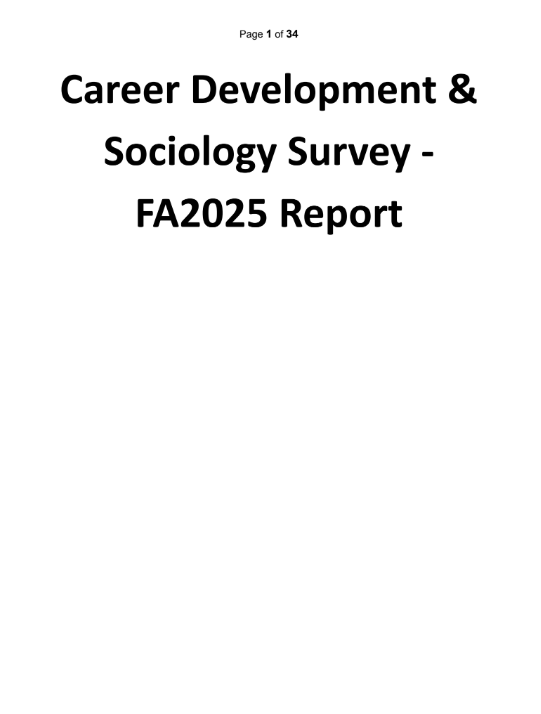
Career Development in Sociology: Survey & Report
This research explores how sociology students understand career readiness, transferable skills, and professional confidence within higher education. I designed and analyzed a 30-question quantitative survey, authored a 34-page report translating findings into actionable recommendations, and presented insights that directly informed Sociology Department curriculum and syllabus updates.
Award
Awarded the “Sociology Student Service Award” in recognition of outstanding contributions to student support, academic engagement, and leadership in advancing career readiness and departmental initiatives within the Sociology Department at NEIU.
Survey Purpose: Measuring Career Readiness for Sociology Students
As a sociology student and a student worker at NEIU’s Career Development Office, I’ve noticed a significant gap in knowledge among social science students—particularly sociology majors—regarding how to identify and articulate the transferable skills they develop through their coursework and academic experiences. Unlike STEM or professionally-focused pathways, where a degree often directly aligns with a specific career (for example, a marketing major gaining technical skills to work in marketing), sociology provides a broad and versatile education that can prepare students for a wide range of roles.
Many sociology students are unsure how to connect skills such as critical thinking, research, data analysis, communication, teamwork, and ethical decision-making to potential careers. Importantly, sociology majors should not feel limited or pigeonholed into one career path simply because their field is less directly vocational. Recognizing and translating these transferable skills is essential for empowering students to explore diverse professional opportunities, confidently pursue internships, and communicate their value to employers across multiple industries.
I identified a need to better understand the career readiness of sociology students and the type of support they require from the Career Development office. To address this, I created a 30-question survey in collaboration with Professor Juan Martinez and Professor Brooke Johnson. The survey assessed students’ resumes, cover letters, transferable skills, internship and job experiences, and confidence in applying their sociology knowledge in professional settings. By collecting this data, we were able to pinpoint areas where students felt prepared and where additional guidance was needed. Because this was the first large-scale campaign I started myself, my participant goal was to have at least 25% of all sociology students take the survey.
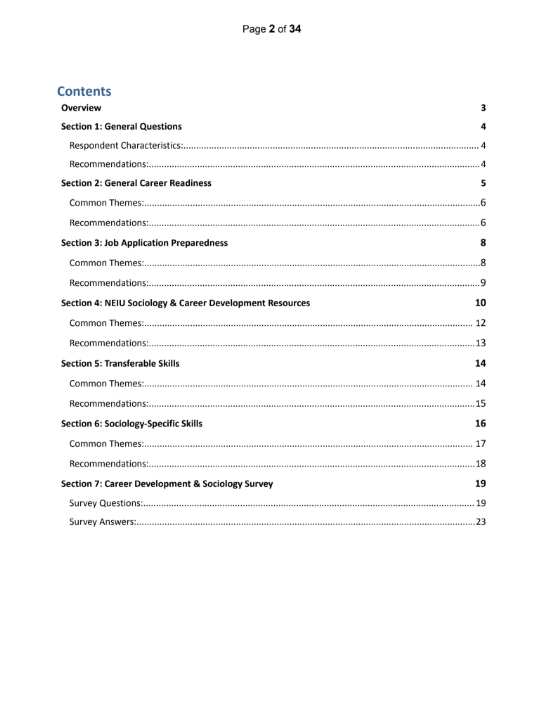
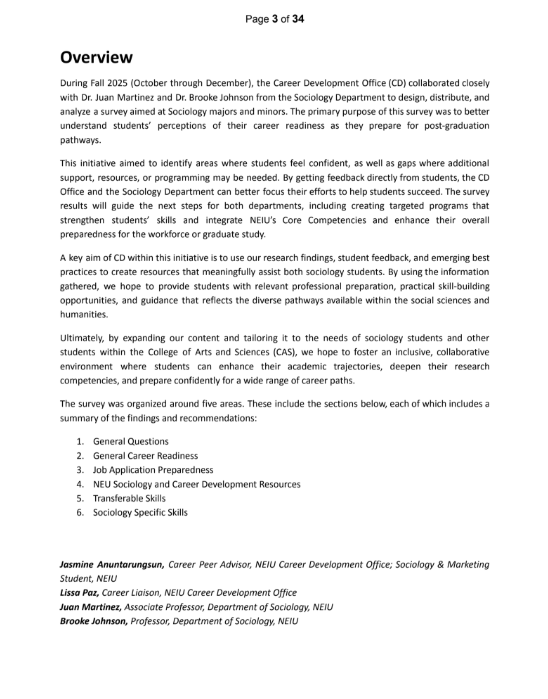
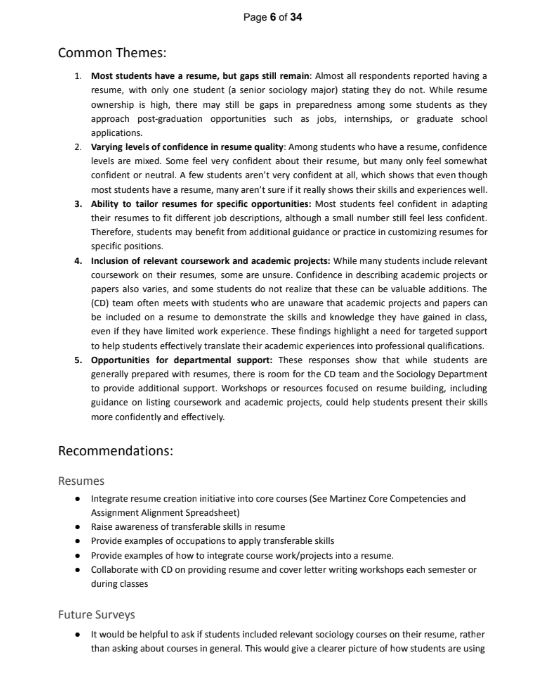
After collecting survey responses, I conducted quantitative analysis to identify common themes, patterns, and statistical trends across student responses. I examined the data question by question and synthesized findings into a comprehensive 34-page report that included a detailed synopsis of results, key insights from each survey item, and data-informed recommendations for faculty. The report highlighted gaps in student confidence and clarity around transferable skills, as well as opportunities to better integrate career readiness into the sociology curriculum.
Following the completion of the report, I presented my findings to the full Sociology Department faculty and staff. As a result of this presentation, faculty incorporated several of the recommendations into their course syllabi, strengthening the emphasis on career readiness, transferable skills, and applied learning within sociology coursework to better support students in preparing for post-graduate opportunities.
Featured Pages from Survey Report
Decolonize Chicago Public Schools’ Curriculum
From 2016 to 2018, I spearheaded the “Decolonize CPS Curriculum” campaign. As a Chicago Public Schools alumna from a neighborhood high school with disproportionately low funding compared to selective enrollment schools, which are typically located on Chicago’s North Side, I observed firsthand how the English curriculum centered primarily on Eurocentric narratives. The histories and stories of people of color were often relegated to elective courses — or omitted entirely — despite the fact that over 83% of CPS students are students of color. For example, during my time in CPS, I read Romeo and Juliet three separate times, while texts representing diverse voices were rarely included in the required curriculum. This experience highlighted the urgent need for a more inclusive and equitable approach to education that reflects the backgrounds and experiences of all students.
Our campaign was driven by the belief that incorporating the experiences of people of color into the core curriculum would not only help students of color relate more deeply to their education but also improve their academic performance. Additionally, we argued that decentering dominant narratives and uplifting the histories, families, and lived experiences of people of color could help reduce instances of bullying and microaggressions in classrooms — from teachers, administrators, and peers alike. This work reinforced my commitment to advocating for an educational system that is both inclusive and equitable, reflecting the backgrounds and experiences of all students.
To lay the foundation for this campaign, I designed and administered a survey to CPS high school students, receiving a total of 148 responses. Among respondents:
78% identified as students of color
81% attended neighborhood high schools
65% reported having six or more books listed on their syllabus for the school year
The survey revealed several key insights:
Only 11% of students reported having four or more authors of color included in their syllabus
20% indicated that no authors of color were represented in their curriculum
While 100% of students at selective enrollment schools felt comfortable sharing their opinions in class, 25% of students at neighborhood high schools reported feeling uncomfortable
In an open-ended question, “List one thing you dislike about your English class,” many of the responses included:
How direct and one sided it is. There is not much room for individuality.
Some people talk more than others when having discussions.
It is very judgmental and people in class don’t show much respect.
I won't need to know any of this for the real world.
I don’t like how we don’t read realistic books.
What encouraged us to move forward with this campaign was:
96% of students stated they wanted to read more books written by authors of color
In response to an open-ended question asking which topics students most wanted to learn, answers highlighted a wide range of areas, including Latino/a/x culture, Black history, Asian history, Indigenous/Native American history, Middle Eastern history and culture, the Civil Rights Movement, women’s empowerment, feminism, gender roles and sexism, police brutality, immigration, international political relations, war, and cultural studies.